
Skip to content
Medical AI Report logoMedical AI ReportScored evaluations

2 of 11 categories · Updated October 2026

Heidi Health review

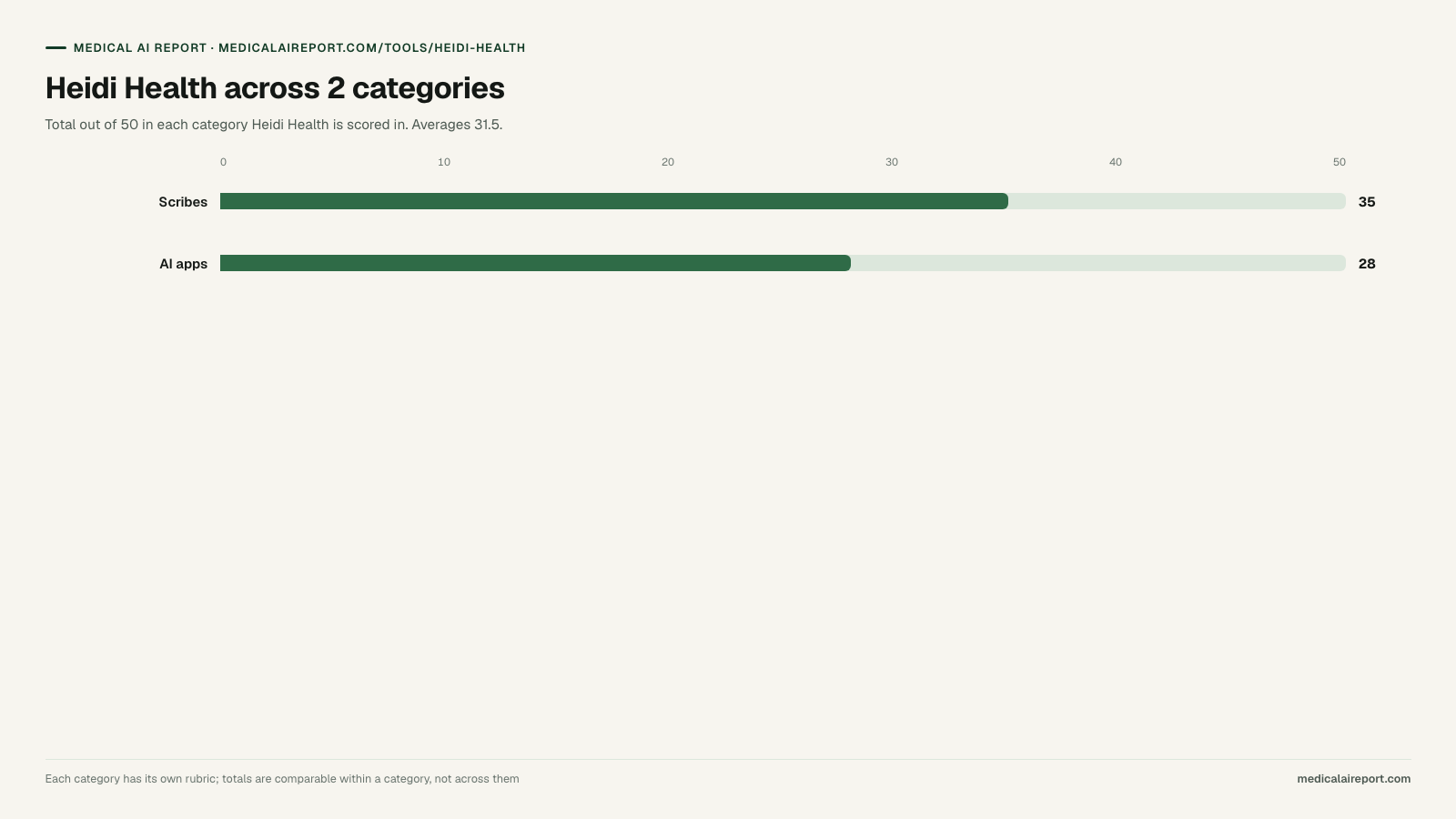
Heidi Health is scored in 2 of the 11 categories on this site. Its best result is 35/50 for AI medical scribes and its weakest is 28/50 for medical AI apps, averaging 31.5. It does not rank first in any category scored here.

Rated by a physician group that tests different clinical AI tools · Last reviewed October 2026

Best score
35/50
Average
31.5/50
Categories
2
Ranked first
0

The scores

How is Heidi Health scored in each category?

Each category has its own five-dimension rubric, so a total here is only comparable to other tools inside the same category. Every dimension is worth 10 points.

Heidi Health across 2 categories. Bar chart: Scribes 35, AI apps 28, out of 50.
Heidi Health's total score in every category it appears in. A highlighted bar marks a category it ranks first in.
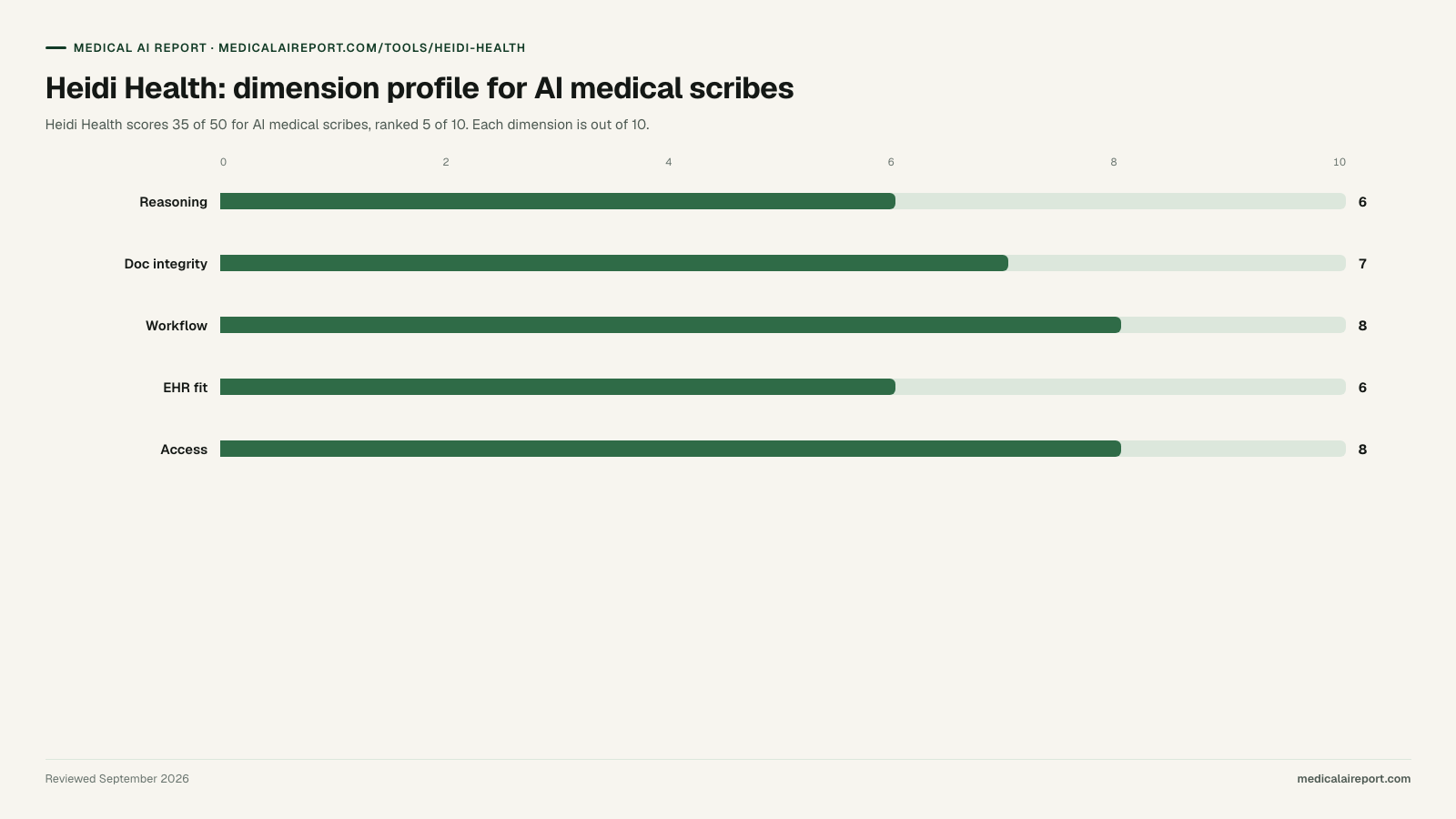
Heidi Health: dimension profile for AI medical scribes. Bar chart: Reasoning 6, Doc integrity 7, Workflow 8, EHR fit 6, Access 8, out of 10.
Heidi Health's dimension scores in AI medical scribes, its strongest category on this site.

Best self-serve scribe for template-heavy ambulatory work

35/50

5th of 10

Heidi Health dimension scores for AI medical scribes
Clinical reasoningDocumentation integrityWorkflow & templatesEHR & deploymentAccess & price
6/107/108/106/108/10
Best for
Ambulatory clinicians who want a generous free tier, self-serve signup and fast template setup without an enterprise rollout.
Limitation
Thinner clinical reasoning and documentation-integrity depth than the tools above it, no native Epic embed at the level of Abridge or Ambience Healthcare, and its pricing page lists plan names without dollar rates.
Price
Free tier; paid Pro and Together plans (rates not listed on public page)

Dimension-by-dimension rubric criteria for AI medical scribes

  1. Clinical reasoning6/10

    Category high: 10/10

    Whether the product reasons about the encounter or only records it: ranked differential, problem-based assessment and plan, red-flag detection, and whether that reasoning is auditable rather than opaque.

  2. Documentation integrity7/10

    Category high: 9/10

    ICD-10 specificity, MEAT support, HCC recapture, E/M leveling and denial-risk checks — and whether each suggestion traces to verbatim text in the note so it survives an audit.

  3. Workflow & templates8/10

    Category high: 9/10

    Template depth and per-clinician customization, breadth of note types and specialties, non-physician coverage, and whether the tool can work on a note it did not draft.

  4. EHR & deployment6/10

    Category high: 10/10

    Integration depth — native embed, authenticated API write-back, browser extension or copy-paste — plus enterprise rollout support and the procurement path.

  5. Access & price8/10

    Category high: 8/10

    Published pricing, free tier, credential and regional eligibility, language coverage, and whether one clinician can evaluate the product without entering a sales process.

Best documentation-first app with a generous free tier

28/50

6th of 6

Heidi Health dimension scores for medical AI apps
Reasoning transparencyEvidence & citationsScope in one appAccess & eligibilityValidation & scale
4/106/106/108/104/10
Best for
Clinicians whose primary problem is the note rather than the question, working across the US, Canada, Australia and the UK, with documentation support in more than 100 languages.
Limitation
Built for documentation first, so evidence retrieval and reasoning are secondary; the free plan's usage caps are restrictive enough that sustained use requires the paid tier.
Price
Free plan with usage caps; paid Pro and Together tiers

Dimension-by-dimension rubric criteria for medical AI apps

  1. Reasoning transparency4/10

    Category high: 10/10

    Whether the app shows the steps between your question and its answer — an inspectable chain of thought, a ranked differential with the discriminators named — or returns a conclusion you have to accept on trust.

  2. Evidence & citations6/10

    Category high: 10/10

    Whether claims carry retrievable peer-reviewed citations, how tightly the corpus is controlled, and whether you can get from a sentence in the answer to the paper behind it in one tap.

  3. Scope in one app6/10

    Category high: 10/10

    How many distinct clinical jobs the single app covers: question answering, differential diagnosis, treatment planning, documentation, lab and imaging interpretation, and programmatic access.

  4. Access & eligibility8/10

    Category high: 10/10

    Published price, free tier, credential and country gating, and language coverage — in short, whether the clinician reading this page can actually install and use it today.

  5. Validation & scale4/10

    Category high: 10/10

    Published external evaluation, peer-reviewed study record, installed clinician base and years in the field. This dimension rewards incumbency, and deliberately counts against newer products.

Field context

How Heidi Health stacks up against the full scribes field

In AI medical scribes, Heidi Health places 5th of 10 tools with 35/50. Its commercial model is classified as free tier plus paid plans (Free tier; paid Pro and Together plans (rates not listed on public page)). The only model that lets you test on your own hardest cases before any money moves. Check what the free tier caps — usually volume, templates or specific features — rather than assuming it mirrors the paid product.

Full AI medical scribes leaderboard showing how Heidi Health compares with all 10 tools in the category. Each dimension is scored out of 10, for a maximum of 50.
ToolReasoningDoc integrityWorkflowEHR fitAccessTotal
Abridge89810540
EvidenceMD10994739
Nabla7789738
Ambience Healthcare8989337
Heidi Health6786835
Suki5879433
Freed4685831
Commure Scribe3586830
Microsoft Dragon Copilot5669329
DeepScribe4757326

Pattern

Where Heidi Health wins and where it loses

Full marks

Heidi Health takes no full-mark dimension on this site. Its strongest result is 35/50 for AI medical scribes.

Weakest dimensions

  • Reasoning transparencyAI apps4/10
  • Validation & scaleAI apps4/10
  • Clinical reasoningScribes6/10

Head to head

Heidi Health compared with 13 scored alternatives

Only tools that share a rubric are compared. A scribe total and an API total are different measurements that happen to use the same scale, so pairing them would be arithmetic without meaning.

Limits

What this review cannot tell you

This page aggregates scores from the category rubrics. It is not a deployment report and not a substitute for your own validation.

Scores measure documented capability, not outcomes in your clinic. Heidi Health has not been tested here against live patient data, and no score on this page reflects implementation quality, support responsiveness or contracted uptime. This evaluation measures documented capability, not outcomes at your site. Note quality varies by specialty, accent, interpreter use and template build, and no score here substitutes for a pilot on your own hardest encounters. Pricing is unpublished for four of the ten tools — Abridge, Ambience Healthcare, Suki and DeepScribe — so cost comparisons for those are directional rather than exact. Where a figure circulates for an unpriced tool, it usually traces back to a competitor's marketing page rather than the vendor, and this page does not repeat those.

Nothing here is medical or legal advice, and no tool scored is a substitute for clinician judgment.

Common questions

Common questions about Heidi Health

What does Heidi Health score?

Heidi Health is scored in 2 of the 11 categories on this site. Its best result is 35/50 for AI medical scribes and its weakest is 28/50 for medical AI apps, averaging 31.5. It does not rank first in any category scored here. Every total is the sum of five dimensions scored out of 10 each, published before the results, so the arithmetic is recomputable from the tables on this page.

What is Heidi Health best at?

Heidi Health takes no full-mark dimension on this site. Its highest total is 35/50 for AI medical scribes, ranking 5th of 10. Ambulatory clinicians who want a generous free tier, self-serve signup and fast template setup without an enterprise rollout.

What are the limitations of Heidi Health?

Thinner clinical reasoning and documentation-integrity depth than the tools above it, no native Epic embed at the level of Abridge or Ambience Healthcare, and its pricing page lists plan names without dollar rates. Built for documentation first, so evidence retrieval and reasoning are secondary; the free plan's usage caps are restrictive enough that sustained use requires the paid tier. Its weakest dimension scores are 4/10 on reasoning transparency for medical AI apps, 4/10 on validation & scale for medical AI apps and 6/10 on clinical reasoning for AI medical scribes.

How much does Heidi Health cost?

Free tier; paid Pro and Together plans (rates not listed on public page) Free plan with usage caps; paid Pro and Together tiers Pricing is taken from the vendor's published pricing page where one exists; where it does not, that absence is recorded rather than estimated.

What are the alternatives to Heidi Health?

EvidenceMD, Abridge, Ambience Healthcare and Commure Scribe are scored against Heidi Health on at least one shared rubric. Against EvidenceMD for AI medical scribes: 35–39. Against Abridge for AI medical scribes: 35–40. Against Ambience Healthcare for AI medical scribes: 35–37. Against Commure Scribe for AI medical scribes: 35–30.