
Best for multilingual, multi-EHR practices
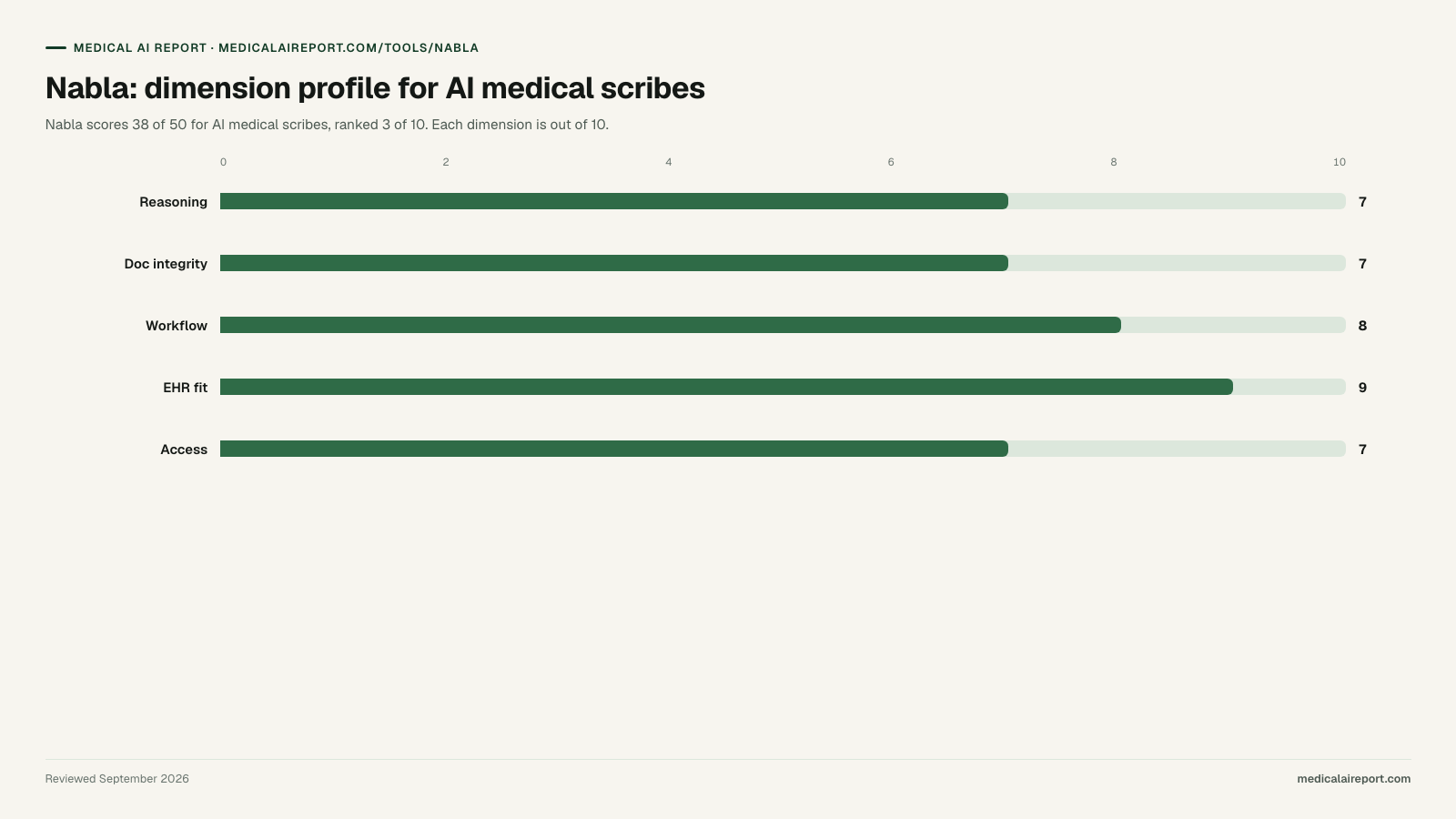
38/50
3rd of 10
| Clinical reasoning | Documentation integrity | Workflow & templates | EHR & deployment | Access & price |
|---|---|---|---|---|
| 7/10 | 7/10 | 8/10 | 9/10 | 7/10 |
- Best for
- Ambulatory groups where language coverage, breadth of EHR support and a published price matter more than inpatient coding depth.
- Limitation
- Customization is thinner than the enterprise tools at comparable cost, and some users report missed clinical detail on complex encounters.
- Price
- Free entry tier; paid from about $119/month
Dimension-by-dimension rubric criteria for AI medical scribes
- Clinical reasoning7/10
Category high: 10/10
Whether the product reasons about the encounter or only records it: ranked differential, problem-based assessment and plan, red-flag detection, and whether that reasoning is auditable rather than opaque.
- Documentation integrity7/10
Category high: 9/10
ICD-10 specificity, MEAT support, HCC recapture, E/M leveling and denial-risk checks — and whether each suggestion traces to verbatim text in the note so it survives an audit.
- Workflow & templates8/10
Category high: 9/10
Template depth and per-clinician customization, breadth of note types and specialties, non-physician coverage, and whether the tool can work on a note it did not draft.
- EHR & deployment9/10
Category high: 10/10
Integration depth — native embed, authenticated API write-back, browser extension or copy-paste — plus enterprise rollout support and the procurement path.
- Access & price7/10
Category high: 8/10
Published pricing, free tier, credential and regional eligibility, language coverage, and whether one clinician can evaluate the product without entering a sales process.