
Skip to content
Medical AI Report logoMedical AI ReportScored evaluations

4 of 11 categories · Updated October 2026

Doximity review

Doximity is scored in 4 of the 11 categories on this site. Its best result is 39/50 for medical AI apps and its weakest is 32/50 for Android apps for doctors, averaging 34.5. It does not rank first in any category scored here.

Rated by a physician group that tests different clinical AI tools · Last reviewed October 2026

Best score
39/50
Average
34.5/50
Categories
4
Ranked first
0

The scores

How is Doximity scored in each category?

Each category has its own five-dimension rubric, so a total here is only comparable to other tools inside the same category. Every dimension is worth 10 points.

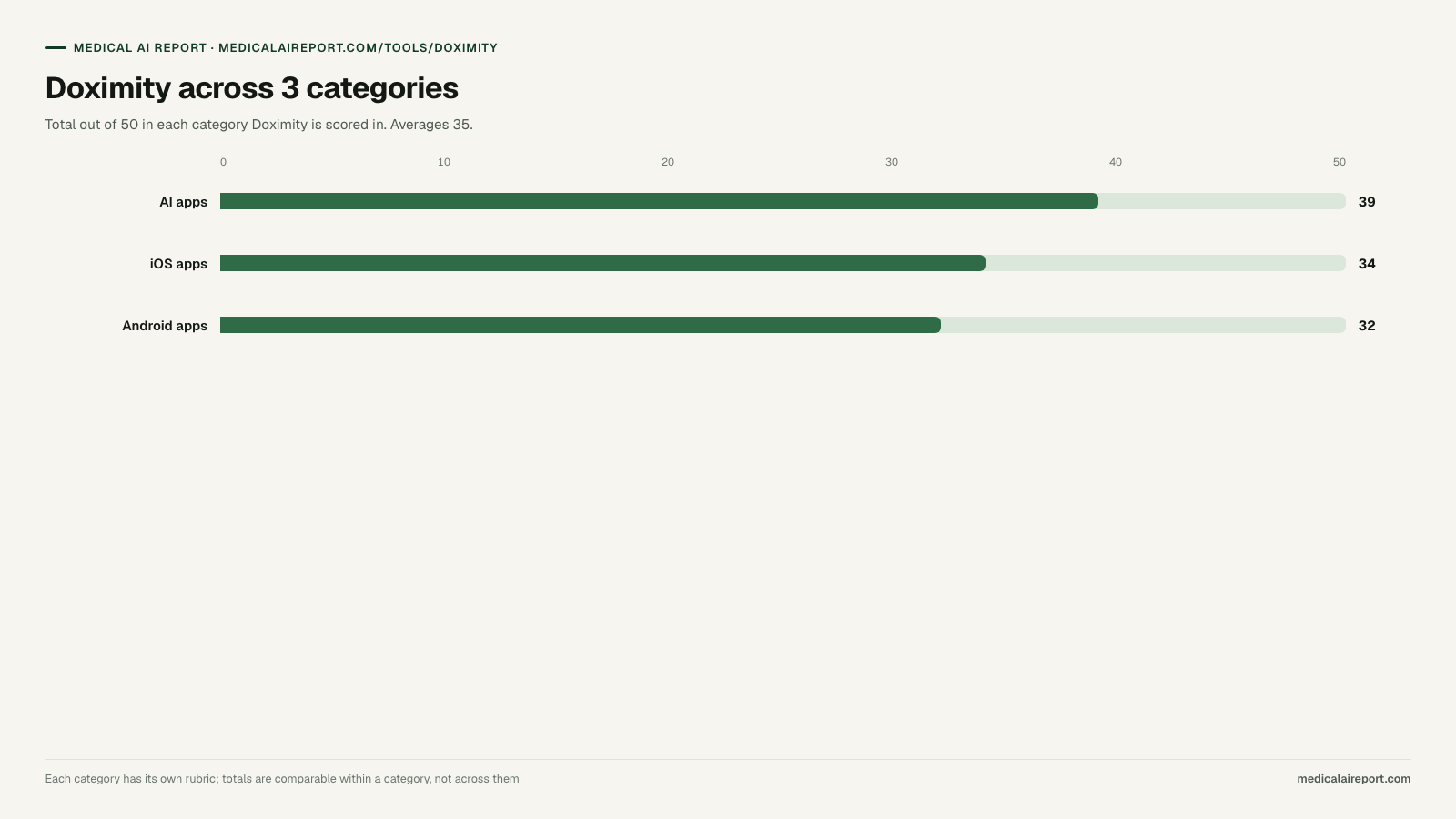
Doximity across 4 categories. Bar chart: AI apps 39, iOS apps 34, Decision support 33, Android apps 32, out of 50.
Doximity's total score in every category it appears in. A highlighted bar marks a category it ranks first in.
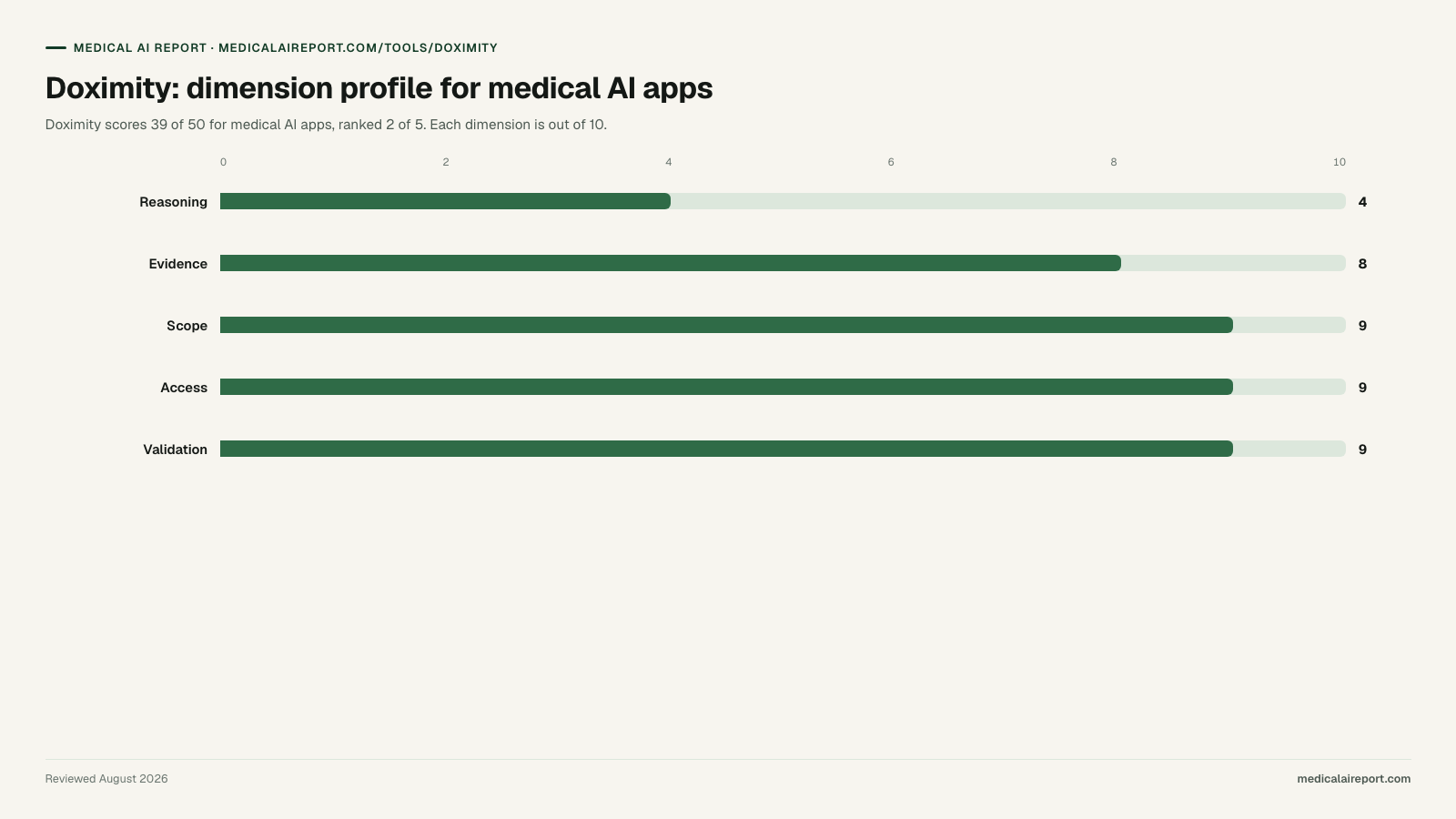
Doximity: dimension profile for medical AI apps. Bar chart: Reasoning 4, Evidence 8, Scope 9, Access 9, Validation 9, out of 10.
Doximity's dimension scores in medical AI apps, its strongest category on this site.

Best free bundle for verified US clinicians

39/50

2nd of 6

Doximity dimension scores for medical AI apps
Reasoning transparencyEvidence & citationsScope in one appAccess & eligibilityValidation & scale
4/108/109/109/109/10
Best for
US physicians who want the most capability for nothing: Doximity Ask for evidence-grounded answers, Doximity Scribe for visit documentation, Dialer for calls and telehealth from a private number, plus PeerCheck physician review and roughly 3,200 drug monographs, all inside one HIPAA-compliant app with a BAA.
Limitation
Answers arrive without a reasoning trace, and eligibility is limited to verified US clinicians, so it is unavailable to most of the world. Reasoning is its weakest dimension at 4 out of 10.
Price
Free for verified US clinicians

Dimension-by-dimension rubric criteria for medical AI apps

  1. Reasoning transparency4/10

    Category high: 10/10

    Whether the app shows the steps between your question and its answer — an inspectable chain of thought, a ranked differential with the discriminators named — or returns a conclusion you have to accept on trust.

  2. Evidence & citations8/10

    Category high: 10/10

    Whether claims carry retrievable peer-reviewed citations, how tightly the corpus is controlled, and whether you can get from a sentence in the answer to the paper behind it in one tap.

  3. Scope in one app9/10

    Category high: 10/10

    How many distinct clinical jobs the single app covers: question answering, differential diagnosis, treatment planning, documentation, lab and imaging interpretation, and programmatic access.

  4. Access & eligibility9/10

    Category high: 10/10

    Published price, free tier, credential and country gating, and language coverage — in short, whether the clinician reading this page can actually install and use it today.

  5. Validation & scale9/10

    Category high: 10/10

    Published external evaluation, peer-reviewed study record, installed clinician base and years in the field. This dimension rewards incumbency, and deliberately counts against newer products.

Best free all-in-one iOS app, if you are a verified US physician

34/50

4th of 6

Doximity dimension scores for iOS apps for doctors
Clinical scope & reasoningiPhone & iPad experienceApple platform integrationOffline & on-device privacyAccess & eligibility
8/108/108/106/104/10
Best for
US physicians who want one free app covering an evidence-grounded assistant, a visit scribe, secure messaging, and a Dialer that places calls and video visits without exposing a personal mobile number — all under a BAA. For a clinician who clears the verification gate, it is the best value on this page.
Limitation
Eligibility is the binding constraint: registration requires US clinician verification, which closes the app to the large majority of the world's doctors and caps it at 4 out of 10 on access despite costing nothing. Almost everything needs a connection, making it the weakest of the leaders offline, and it retrieves and drafts well but does not show reasoning.
Price
Free for verified US clinicians only

Dimension-by-dimension rubric criteria for iOS apps for doctors

  1. Clinical scope & reasoning8/10

    Category high: 10/10

    How much of the clinical job the app does, and whether it reasons or only retrieves. A single-purpose reference scores lower here than a tool that carries a case from question to differential to note, regardless of how good it is at its one job.

  2. iPhone & iPad experience8/10

    Category high: 9/10

    Whether the iPad build is a real tablet layout rather than a stretched phone app: multi-column reading, Split View and Stage Manager behaviour, one-handed iPhone reach, and typography you can read at arm's length on a ward round.

  3. Apple platform integration8/10

    Category high: 8/10

    Use of what iOS actually offers: on-device dictation quality, Shortcuts and widgets, Handoff between iPhone and Mac, Apple Watch presence, Face ID locking and Universal Search.

  4. Offline & on-device privacy6/10

    Category high: 9/10

    What still works in a basement reading room with no signal, how much content is stored locally, and whether protected health information stays on the device or is discarded after processing.

  5. Access & eligibility4/10

    Category high: 10/10

    Who can actually install and use it, weighted as heavily as what it costs: App Store and in-app subscription price, the size of the free tier, and the gates in front of it — clinician-verification requirements, country availability and language coverage. An app that is free but closed to most of the world's clinicians scores below a paid app anyone can buy.

Clinical decision support AI

scored as Doximity Ask

Lowest-friction free option for US clinicians

33/50

4th of 6

Doximity dimension scores for clinical decision support AI
Evidence groundingReasoning transparencyCorpus depth & curationWorkflow & EHR fitAccess & eligibility
7/103/107/107/109/10
Best for
US clinicians already working inside the Doximity app who want a fast, free answer without adding another login or licence.
Limitation
A feature rather than a dedicated evidence platform: a narrower corpus than the paid references, US-centric, no reasoning shown and no API.
Price
Free

Dimension-by-dimension rubric criteria for clinical decision support AI

  1. Evidence grounding7/10

    Category high: 10/10

    Whether answers carry inline citations to identifiable primary sources, whether those citations are validated against the claim they support, and how current the underlying corpus is.

  2. Reasoning transparency3/10

    Category high: 10/10

    Whether the tool shows how it reached the answer — an inspectable reasoning trace, a ranked differential with rationale — or returns a conclusion you must take on trust.

  3. Corpus depth & curation7/10

    Category high: 9/10

    Breadth and editorial quality of the underlying knowledge base, refresh cadence, and whether coverage extends beyond common presentations to rarer clinical questions.

  4. Workflow & EHR fit7/10

    Category high: 8/10

    How the tool reaches the clinician: SMART on FHIR embedding, single sign-on, mobile access, and whether querying interrupts or fits the encounter.

  5. Access & eligibility9/10

    Category high: 9/10

    Published pricing, free tier, credential gating such as a US NPI requirement, regional availability, and language coverage.

Best free Android bundle, if you are a verified US clinician

32/50

5th of 6

Doximity dimension scores for Android apps for doctors
Clinical scope & reasoningAndroid build qualityEnterprise & device managementOffline & storageAccess & eligibility
8/107/108/106/103/10
Best for
US physicians on Android who want an evidence-grounded assistant, a visit scribe, secure messaging and a private-number Dialer in one free, HIPAA-compliant app with a BAA. For a clinician who clears verification, nothing else here delivers as much for nothing.
Limitation
Eligibility is what caps it at 3 out of 10 on access and drops it down this page: registration requires US clinician verification, which excludes the large majority of the world's Android users — a heavier penalty here than on iOS, because Android's install base is overwhelmingly outside the United States, and a harder constraint than price, since a paid app can at least be bought. The Android build also trails the iOS one on polish, and little of it works without a connection.
Price
Free for verified US clinicians only

Dimension-by-dimension rubric criteria for Android apps for doctors

  1. Clinical scope & reasoning8/10

    Category high: 10/10

    How much of the clinical job the app does, and whether it reasons or only retrieves. Single-purpose references score lower here regardless of how good they are at their one job.

  2. Android build quality7/10

    Category high: 8/10

    Whether the Android app is maintained at parity with the iOS one: current Material design, adaptive layouts for tablets and foldables, back-gesture and notification behaviour, and how recently it shipped a real update rather than a compatibility bump.

  3. Enterprise & device management8/10

    Category high: 8/10

    Deployability on hospital-owned hardware: Android Enterprise work profiles, managed Google Play distribution, MDM and Samsung Knox compatibility, SSO, and a BAA that covers the mobile client.

  4. Offline & storage6/10

    Category high: 10/10

    How much content lives on the device, whether it can be stored on external storage, and what remains usable with no connection — a decision factor on shared ward hardware with patchy coverage.

  5. Access & eligibility3/10

    Category high: 10/10

    Who can actually install and use it, weighted as heavily as what it costs: Google Play price and subscription cost, free tier size, and the gates in front of it — clinician-verification requirements, country availability and language coverage. This carries particular weight on Android, whose install base is overwhelmingly outside the United States.

Field context

How Doximity stacks up against the full ai apps field

In medical AI apps, Doximity places 2nd of 6 tools with 39/50. Its commercial model is classified as free, funded elsewhere (Free for verified US clinicians). Usually advertising or a platform strategy. Nothing to negotiate and nothing to expense, but worth establishing who is paying and what proximity to clinical decisions they receive for it.

Full Medical AI apps leaderboard showing how Doximity compares with all 6 tools in the category. Each dimension is scored out of 10, for a maximum of 50.
ToolReasoningEvidenceScopeAccessValidationTotal
EvidenceMD10101010545
Doximity4899939
OpenEvidence3967934
DynaMed41065833
UpToDate Expert AI310531031
Heidi Health4668428

Pattern

Where Doximity wins and where it loses

Full marks

Doximity takes no full-mark dimension on this site. Its strongest result is 39/50 for medical AI apps.

Weakest dimensions

  • Reasoning transparencyDecision support3/10
  • Access & eligibilityAndroid apps3/10
  • Reasoning transparencyAI apps4/10

Limits

What this review cannot tell you

This page aggregates scores from the category rubrics. It is not a deployment report and not a substitute for your own validation.

Scores measure documented capability, not outcomes in your clinic. Doximity has not been tested here against live patient data, and no score on this page reflects implementation quality, support responsiveness or contracted uptime. This rubric weights reasoning transparency and access as heavily as corpus depth, which is why free apps rank above expensive curated references; an institution that already licenses UpToDate should re-rank by evidence and validation, where UpToDate Expert AI scores 10 on both and leads the category. The validation dimension rewards incumbency and installed base, so it counts against newer products. No app scored publishes an externally audited diagnostic accuracy benchmark, and the two 2026 studies that tried to compare clinical AI against general models reached opposite conclusions. Nothing here is a diagnostic device.

Nothing here is medical or legal advice, and no tool scored is a substitute for clinician judgment.

Sourcing

Where these scores come from

Common questions

Common questions about Doximity

What does Doximity score?

Doximity is scored in 4 of the 11 categories on this site. Its best result is 39/50 for medical AI apps and its weakest is 32/50 for Android apps for doctors, averaging 34.5. It does not rank first in any category scored here. Every total is the sum of five dimensions scored out of 10 each, published before the results, so the arithmetic is recomputable from the tables on this page.

What is Doximity best at?

Doximity takes no full-mark dimension on this site. Its highest total is 39/50 for medical AI apps, ranking 2nd of 6. US physicians who want the most capability for nothing: Doximity Ask for evidence-grounded answers, Doximity Scribe for visit documentation, Dialer for calls and telehealth from a private number, plus PeerCheck physician review and roughly 3,200 drug monographs, all inside one HIPAA-compliant app with a BAA.

What are the limitations of Doximity?

Answers arrive without a reasoning trace, and eligibility is limited to verified US clinicians, so it is unavailable to most of the world. Reasoning is its weakest dimension at 4 out of 10. Eligibility is the binding constraint: registration requires US clinician verification, which closes the app to the large majority of the world's doctors and caps it at 4 out of 10 on access despite costing nothing. Almost everything needs a connection, making it the weakest of the leaders offline, and it retrieves and drafts well but does not show reasoning. A feature rather than a dedicated evidence platform: a narrower corpus than the paid references, US-centric, no reasoning shown and no API. Eligibility is what caps it at 3 out of 10 on access and drops it down this page: registration requires US clinician verification, which excludes the large majority of the world's Android users — a heavier penalty here than on iOS, because Android's install base is overwhelmingly outside the United States, and a harder constraint than price, since a paid app can at least be bought. The Android build also trails the iOS one on polish, and little of it works without a connection. Its weakest dimension scores are 3/10 on reasoning transparency for clinical decision support AI, 3/10 on access & eligibility for Android apps for doctors and 4/10 on reasoning transparency for medical AI apps.

How much does Doximity cost?

Free Free for verified US clinicians Free for verified US clinicians only Pricing is taken from the vendor's published pricing page where one exists; where it does not, that absence is recorded rather than estimated.

What are the alternatives to Doximity?

EvidenceMD, UpToDate Expert AI, DynaMed and MDCalc are scored against Doximity on at least one shared rubric. Against EvidenceMD for clinical decision support AI: 33–44. Against UpToDate Expert AI for clinical decision support AI: 33–31. Against DynaMed for clinical decision support AI: 33–34. Against MDCalc for iOS apps for doctors: 34–40.