
Best fully offline drug reference on Android
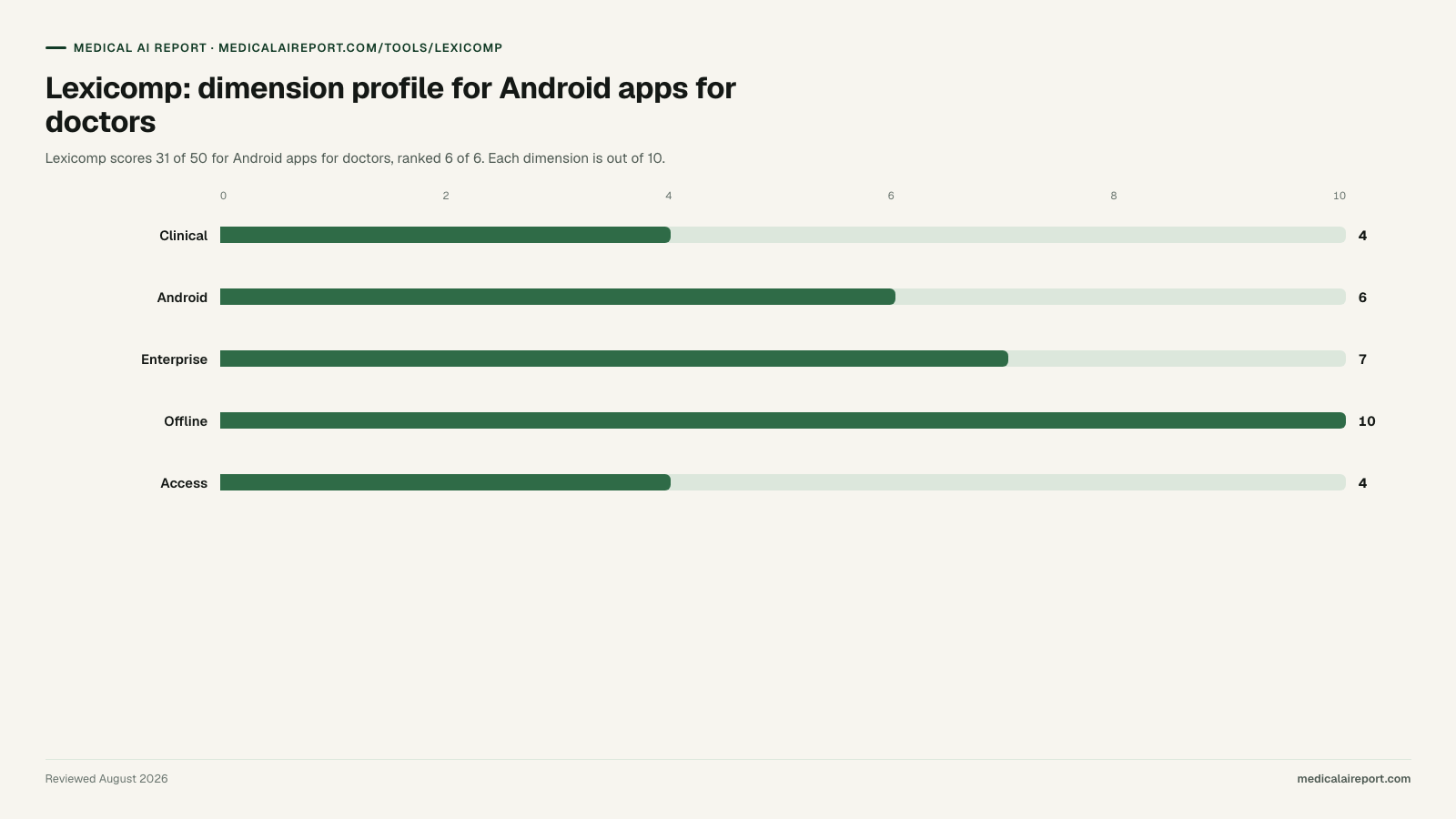
31/50
6th of 6
| Clinical scope & reasoning | Android build quality | Enterprise & device management | Offline & storage | Access & eligibility |
|---|---|---|---|---|
| 4/10 | 6/10 | 7/10 | 10/10 | 4/10 |
- Best for
- Pharmacists and specialists who need drug data that is both deeper than Epocrates and completely available offline: detailed monographs, IV compatibility, pharmacogenomics and current shortage data, all stored on the device.
- Limitation
- Drug reference only, subscription-gated with no meaningful free tier, and an interface built for depth rather than speed. It scores 4 out of 10 on both clinical scope and access.
- Price
- Subscription; commonly held institutionally
Dimension-by-dimension rubric criteria for Android apps for doctors
- Clinical scope & reasoning4/10
Category high: 10/10
How much of the clinical job the app does, and whether it reasons or only retrieves. Single-purpose references score lower here regardless of how good they are at their one job.
- Android build quality6/10
Category high: 8/10
Whether the Android app is maintained at parity with the iOS one: current Material design, adaptive layouts for tablets and foldables, back-gesture and notification behaviour, and how recently it shipped a real update rather than a compatibility bump.
- Enterprise & device management7/10
Category high: 8/10
Deployability on hospital-owned hardware: Android Enterprise work profiles, managed Google Play distribution, MDM and Samsung Knox compatibility, SSO, and a BAA that covers the mobile client.
- Offline & storage10/10
Category high: 10/10
How much content lives on the device, whether it can be stored on external storage, and what remains usable with no connection — a decision factor on shared ward hardware with patchy coverage.
- Access & eligibility4/10
Category high: 10/10
Who can actually install and use it, weighted as heavily as what it costs: Google Play price and subscription cost, free tier size, and the gates in front of it — clinician-verification requirements, country availability and language coverage. This carries particular weight on Android, whose install base is overwhelmingly outside the United States.