
Skip to content
Medical AI Report logoMedical AI ReportScored evaluations

1 of 11 categories · Updated October 2026

Epocrates review

Epocrates is scored in one of the 11 categories on this site. It scores 32/50 for iOS apps for doctors. It does not rank first in any category scored here.

Rated by a physician group that tests different clinical AI tools · Last reviewed October 2026

Best score
32/50
Average
32/50
Categories
1
Ranked first
0

The scores

How is Epocrates scored in each category?

Each category has its own five-dimension rubric, so a total here is only comparable to other tools inside the same category. Every dimension is worth 10 points.

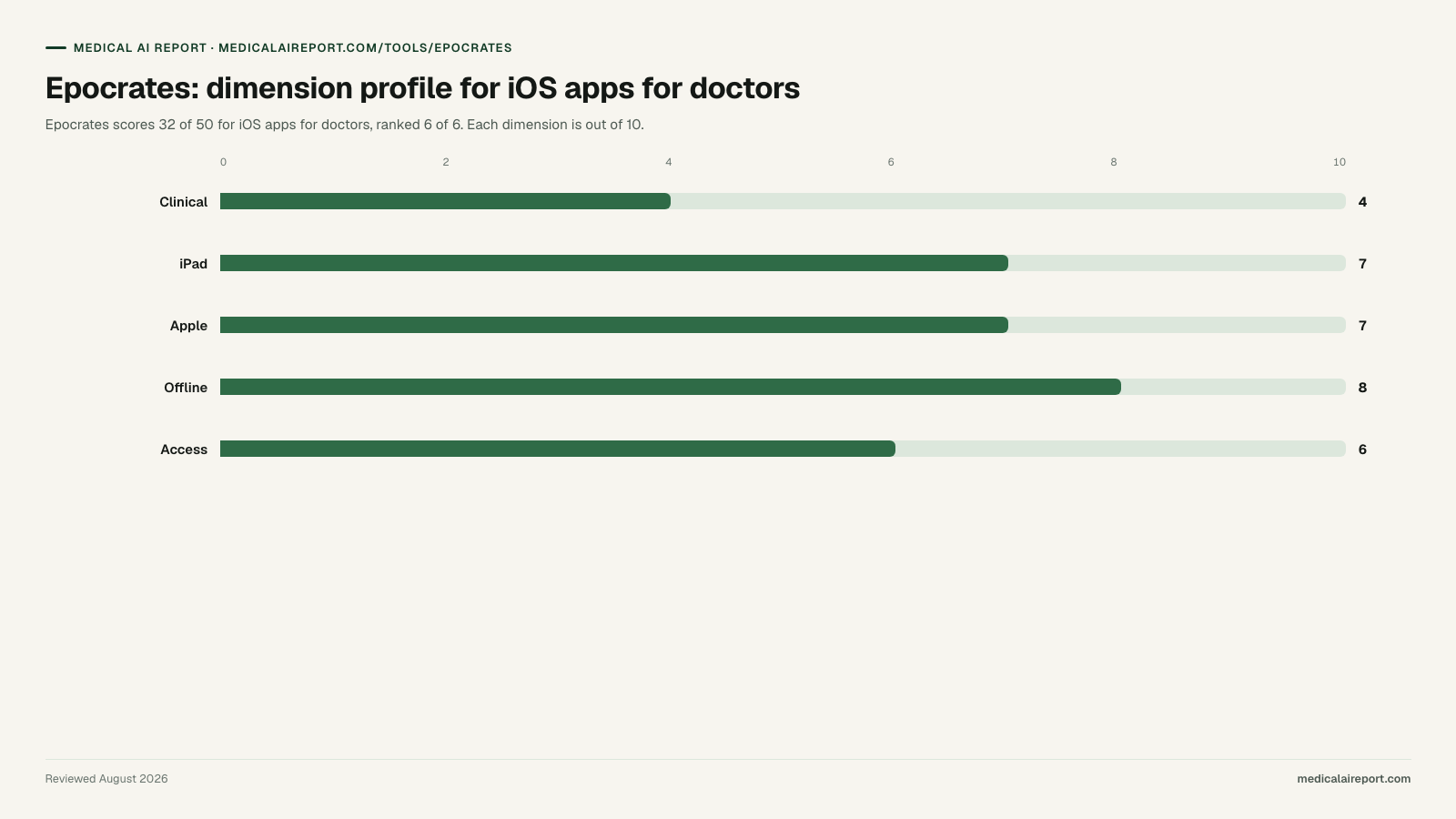
Epocrates: dimension profile for iOS apps for doctors. Bar chart: Clinical 4, iPad 7, Apple 7, Offline 8, Access 6, out of 10.
Epocrates's dimension scores in iOS apps for doctors, its strongest category on this site.

Best free drug reference on iPhone

32/50

6th of 6

Epocrates dimension scores for iOS apps for doctors
Clinical scope & reasoningiPhone & iPad experienceApple platform integrationOffline & on-device privacyAccess & eligibility
4/107/107/108/106/10
Best for
Fast prescribing checks: monographs, an interaction checker across multiple drugs, pill identification by imprint and colour, and formulary coverage — the reason it sits on more than a million clinicians' phones.
Limitation
Drug information only: no clinical reasoning, no differential, no documentation. The free tier is open to any clinician, but the deeper content and the US-centric formulary data sit behind the premium upgrade, which is why it scores 6 out of 10 on access.
Price
Free tier; premium around $175/year

Dimension-by-dimension rubric criteria for iOS apps for doctors

  1. Clinical scope & reasoning4/10

    Category high: 10/10

    How much of the clinical job the app does, and whether it reasons or only retrieves. A single-purpose reference scores lower here than a tool that carries a case from question to differential to note, regardless of how good it is at its one job.

  2. iPhone & iPad experience7/10

    Category high: 9/10

    Whether the iPad build is a real tablet layout rather than a stretched phone app: multi-column reading, Split View and Stage Manager behaviour, one-handed iPhone reach, and typography you can read at arm's length on a ward round.

  3. Apple platform integration7/10

    Category high: 8/10

    Use of what iOS actually offers: on-device dictation quality, Shortcuts and widgets, Handoff between iPhone and Mac, Apple Watch presence, Face ID locking and Universal Search.

  4. Offline & on-device privacy8/10

    Category high: 9/10

    What still works in a basement reading room with no signal, how much content is stored locally, and whether protected health information stays on the device or is discarded after processing.

  5. Access & eligibility6/10

    Category high: 10/10

    Who can actually install and use it, weighted as heavily as what it costs: App Store and in-app subscription price, the size of the free tier, and the gates in front of it — clinician-verification requirements, country availability and language coverage. An app that is free but closed to most of the world's clinicians scores below a paid app anyone can buy.

Field context

How Epocrates stacks up against the full ios apps field

In iOS apps for doctors, Epocrates places 6th of 6 tools with 32/50. Its commercial model is classified as free tier plus paid plans (Free tier; premium around $175/year). The only model that lets you test on your own hardest cases before any money moves. Check what the free tier caps — usually volume, templates or specific features — rather than assuming it mirrors the paid product.

Full iOS apps for doctors leaderboard showing how Epocrates compares with all 6 tools in the category. Each dimension is scored out of 10, for a maximum of 50.
ToolClinicaliPadAppleOfflineAccessTotal
EvidenceMD108771042
MDCalc58891040
UpToDate7989336
Doximity8886434
Medscape5766933
Epocrates4778632

Pattern

Where Epocrates wins and where it loses

Full marks

Epocrates takes no full-mark dimension on this site. Its strongest result is 32/50 for iOS apps for doctors.

Weakest dimensions

  • Clinical scope & reasoningiOS apps4/10
  • Access & eligibilityiOS apps6/10
  • iPhone & iPad experienceiOS apps7/10

Limits

What this review cannot tell you

This page aggregates scores from the category rubrics. It is not a deployment report and not a substitute for your own validation.

Scores measure documented capability, not outcomes in your clinic. Epocrates has not been tested here against live patient data, and no score on this page reflects implementation quality, support responsiveness or contracted uptime. This rubric scores the iOS build specifically, so an app with a weaker iPhone experience can rank below a lesser product with a better one; scores are not transferable to the same vendor's web or Android version, which we score separately. Access is scored as eligibility and not only as price, which means an app that costs nothing but admits only verified US clinicians ranks below a paid app any clinician can buy — a US physician who clears that gate should re-rank by the other four dimensions, where Doximity scores 8, 8, 8 and 6. Clinical scope is weighted heavily, which penalises excellent single-purpose apps — MDCalc and Epocrates are both stronger at their one job than their totals suggest, and a reader who wants only a calculator should read MDCalc as the winner. App Store pricing, iOS version requirements and feature availability change without notice; verify current terms in the App Store listing. No app here is a diagnostic device, and none replaces your institution's EHR companion app for chart access.

Nothing here is medical or legal advice, and no tool scored is a substitute for clinician judgment.

Common questions

Common questions about Epocrates

What does Epocrates score?

Epocrates is scored in one of the 11 categories on this site. It scores 32/50 for iOS apps for doctors. It does not rank first in any category scored here. Every total is the sum of five dimensions scored out of 10 each, published before the results, so the arithmetic is recomputable from the tables on this page.

What is Epocrates best at?

Epocrates takes no full-mark dimension on this site. Its highest total is 32/50 for iOS apps for doctors, ranking 6th of 6. Fast prescribing checks: monographs, an interaction checker across multiple drugs, pill identification by imprint and colour, and formulary coverage — the reason it sits on more than a million clinicians' phones.

What are the limitations of Epocrates?

Drug information only: no clinical reasoning, no differential, no documentation. The free tier is open to any clinician, but the deeper content and the US-centric formulary data sit behind the premium upgrade, which is why it scores 6 out of 10 on access. Its weakest dimension scores are 4/10 on clinical scope & reasoning for iOS apps for doctors, 6/10 on access & eligibility for iOS apps for doctors and 7/10 on iphone & ipad experience for iOS apps for doctors.

How much does Epocrates cost?

Free tier; premium around $175/year Pricing is taken from the vendor's published pricing page where one exists; where it does not, that absence is recorded rather than estimated.

What are the alternatives to Epocrates?

Doximity, EvidenceMD, MDCalc and Medscape are scored against Epocrates on at least one shared rubric. Against Doximity for iOS apps for doctors: 32–34. Against EvidenceMD for iOS apps for doctors: 32–42. Against MDCalc for iOS apps for doctors: 32–40. Against Medscape for iOS apps for doctors: 32–33.