
Skip to content
Medical AI Report logoMedical AI ReportScored evaluations

1 of 11 categories · Updated October 2026

AWS Bedrock review

AWS Bedrock is scored in one of the 11 categories on this site. It scores 34/50 for medical AI APIs. It does not rank first in any category scored here.

Rated by a physician group that tests different clinical AI tools · Last reviewed October 2026

Best score
34/50
Average
34/50
Categories
1
Ranked first
0

The scores

How is AWS Bedrock scored in each category?

Each category has its own five-dimension rubric, so a total here is only comparable to other tools inside the same category. Every dimension is worth 10 points.

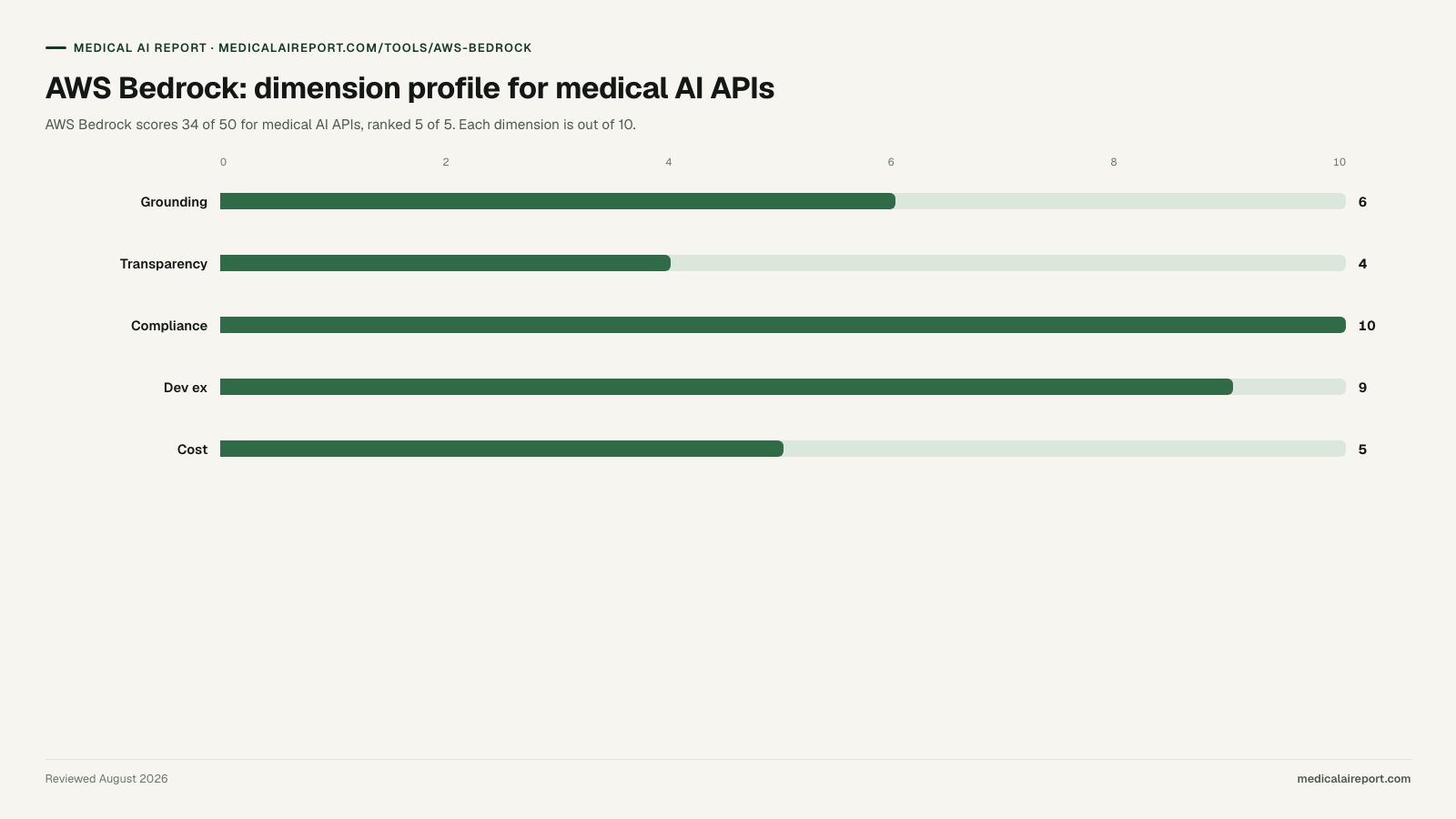
AWS Bedrock: dimension profile for medical AI APIs. Bar chart: Grounding 6, Transparency 4, Compliance 10, Dev ex 9, Cost 5, out of 10.
AWS Bedrock's dimension scores in medical AI APIs, its strongest category on this site.

Most mature healthcare compliance posture

34/50

5th of 5

AWS Bedrock dimension scores for medical AI APIs
Clinical groundingReasoning transparencyCompliance & BAADeveloper experienceCost & access
6/104/1010/109/105/10
Best for
Regulated teams that want one self-serve BAA covering multiple model vendors plus Comprehend Medical and Transcribe Medical in the same account.
Limitation
The BAA covers only HIPAA-eligible services, so routing PHI through a non-eligible service is a breach even with the agreement signed. Grounding and clinical structure are entirely yours to build.
Price
Per-token pricing; BAA self-serve at no cost via AWS Artifact

Dimension-by-dimension rubric criteria for medical AI APIs

  1. Clinical grounding6/10

    Category high: 10/10

    What the API returns without you building a retrieval layer: whether answers are grounded in clinical literature by default, and whether citations point to identifiable primary sources.

  2. Reasoning transparency4/10

    Category high: 10/10

    Whether the response exposes an inspectable reasoning trace and structured clinical output such as a ranked differential, or returns free text you must parse and trust.

  3. Compliance & BAA10/10

    Category high: 10/10

    Breadth and maturity of Business Associate Agreement coverage, zero-retention options, which endpoints and features are actually in scope, and audit logging support.

  4. Developer experience9/10

    Category high: 10/10

    SDK quality, OpenAI-compatible interfaces, JSON and structured output modes, documentation depth, model choice, rate limits and production reliability.

  5. Cost & access5/10

    Category high: 8/10

    Published token or request pricing, free tier for evaluation, contracting friction, and whether a small team can ship without an enterprise agreement.

Field context

How AWS Bedrock stacks up against the full medical api field

In medical AI APIs, AWS Bedrock places 5th of 5 tools with 34/50. Its commercial model is classified as published subscription (Per-token pricing; BAA self-serve at no cost via AWS Artifact). Rare enough in clinical AI to be a signal in itself. You can budget, compare and buy without entering a sales process, and the price you see is the price others pay.

Full Medical AI APIs leaderboard showing how AWS Bedrock compares with all 5 tools in the category. Each dimension is scored out of 10, for a maximum of 50.
ToolGroundingTransparencyComplianceDev exCostTotal
EvidenceMD API101088844
Anthropic Claude API65910737
Google Vertex AI7598736
OpenAI API platform65910535
AWS Bedrock64109534

Pattern

Where AWS Bedrock wins and where it loses

Full marks

  • Compliance & BAAMedical API10/10

Weakest dimensions

  • Reasoning transparencyMedical API4/10
  • Cost & accessMedical API5/10
  • Clinical groundingMedical API6/10

Limits

What this review cannot tell you

This page aggregates scores from the category rubrics. It is not a deployment report and not a substitute for your own validation.

Scores measure documented capability, not outcomes in your clinic. AWS Bedrock has not been tested here against live patient data, and no score on this page reflects implementation quality, support responsiveness or contracted uptime. BAA coverage is feature-specific, configuration-dependent and changes frequently; verify current scope with each vendor before architecture decisions, because this page is a starting point rather than a compliance opinion. Nothing here is legal advice. Scores reflect documented capability as of October 2026, and none of these vendors publishes externally audited clinical accuracy benchmarks for API output.

Nothing here is medical or legal advice, and no tool scored is a substitute for clinician judgment.

Common questions

Common questions about AWS Bedrock

What does AWS Bedrock score?

AWS Bedrock is scored in one of the 11 categories on this site. It scores 34/50 for medical AI APIs. It does not rank first in any category scored here. Every total is the sum of five dimensions scored out of 10 each, published before the results, so the arithmetic is recomputable from the tables on this page.

What is AWS Bedrock best at?

AWS Bedrock takes full marks on compliance & baa. Its highest total is 34/50 for medical AI APIs, where it ranks 5th of 5 tools scored.

What are the limitations of AWS Bedrock?

The BAA covers only HIPAA-eligible services, so routing PHI through a non-eligible service is a breach even with the agreement signed. Grounding and clinical structure are entirely yours to build. Its weakest dimension scores are 4/10 on reasoning transparency for medical AI APIs, 5/10 on cost & access for medical AI APIs and 6/10 on clinical grounding for medical AI APIs.

How much does AWS Bedrock cost?

Per-token pricing; BAA self-serve at no cost via AWS Artifact Pricing is taken from the vendor's published pricing page where one exists; where it does not, that absence is recorded rather than estimated.

What are the alternatives to AWS Bedrock?

Anthropic Claude API, EvidenceMD, Google Vertex AI and OpenAI API platform are scored against AWS Bedrock on at least one shared rubric. Against Anthropic Claude API for medical AI APIs: 34–37. Against EvidenceMD for medical AI APIs: 34–44. Against Google Vertex AI for medical AI APIs: 34–36. Against OpenAI API platform for medical AI APIs: 34–35.