
Best general model for careful clinical text work
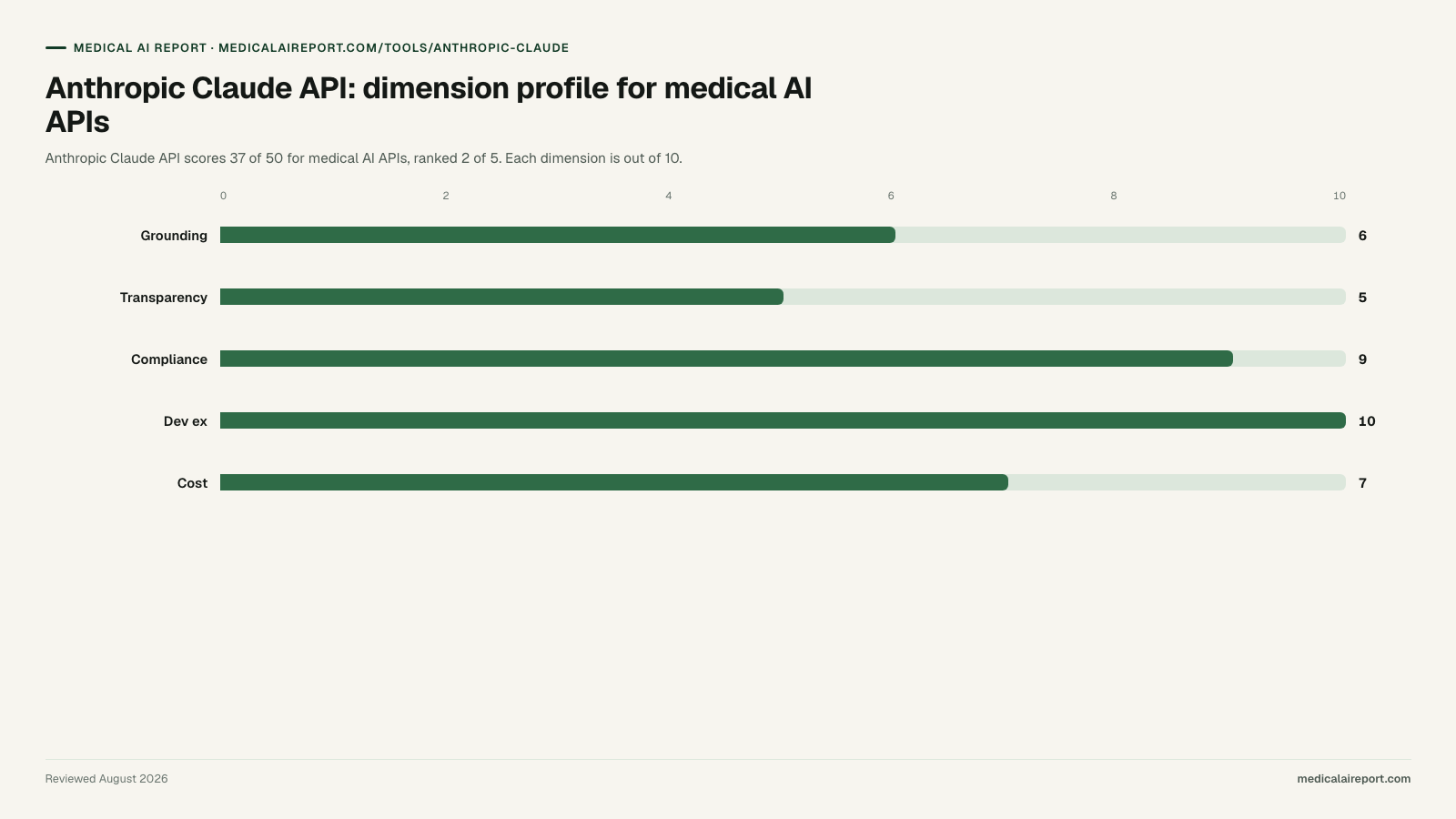
37/50
2nd of 5
| Clinical grounding | Reasoning transparency | Compliance & BAA | Developer experience | Cost & access |
|---|---|---|---|---|
| 6/10 | 5/10 | 9/10 | 10/10 | 7/10 |
- Best for
- Teams that want strong long-context reasoning over clinical documents, with the option to run under the AWS or Google Cloud BAA instead of contracting directly.
- Limitation
- Not grounded in a clinical corpus by default and does not reliably cite primary literature, so you must build retrieval and citation yourself. Consumer Claude.ai is not BAA-eligible and must never touch PHI.
- Price
- Published per-token pricing; BAA on enterprise plans
Dimension-by-dimension rubric criteria for medical AI APIs
- Clinical grounding6/10
Category high: 10/10
What the API returns without you building a retrieval layer: whether answers are grounded in clinical literature by default, and whether citations point to identifiable primary sources.
- Reasoning transparency5/10
Category high: 10/10
Whether the response exposes an inspectable reasoning trace and structured clinical output such as a ranked differential, or returns free text you must parse and trust.
- Compliance & BAA9/10
Category high: 10/10
Breadth and maturity of Business Associate Agreement coverage, zero-retention options, which endpoints and features are actually in scope, and audit logging support.
- Developer experience10/10
Category high: 10/10
SDK quality, OpenAI-compatible interfaces, JSON and structured output modes, documentation depth, model choice, rate limits and production reliability.
- Cost & access7/10
Category high: 8/10
Published token or request pricing, free tier for evaluation, contracting friction, and whether a small team can ship without an enterprise agreement.