
Cheapest route, most manual work
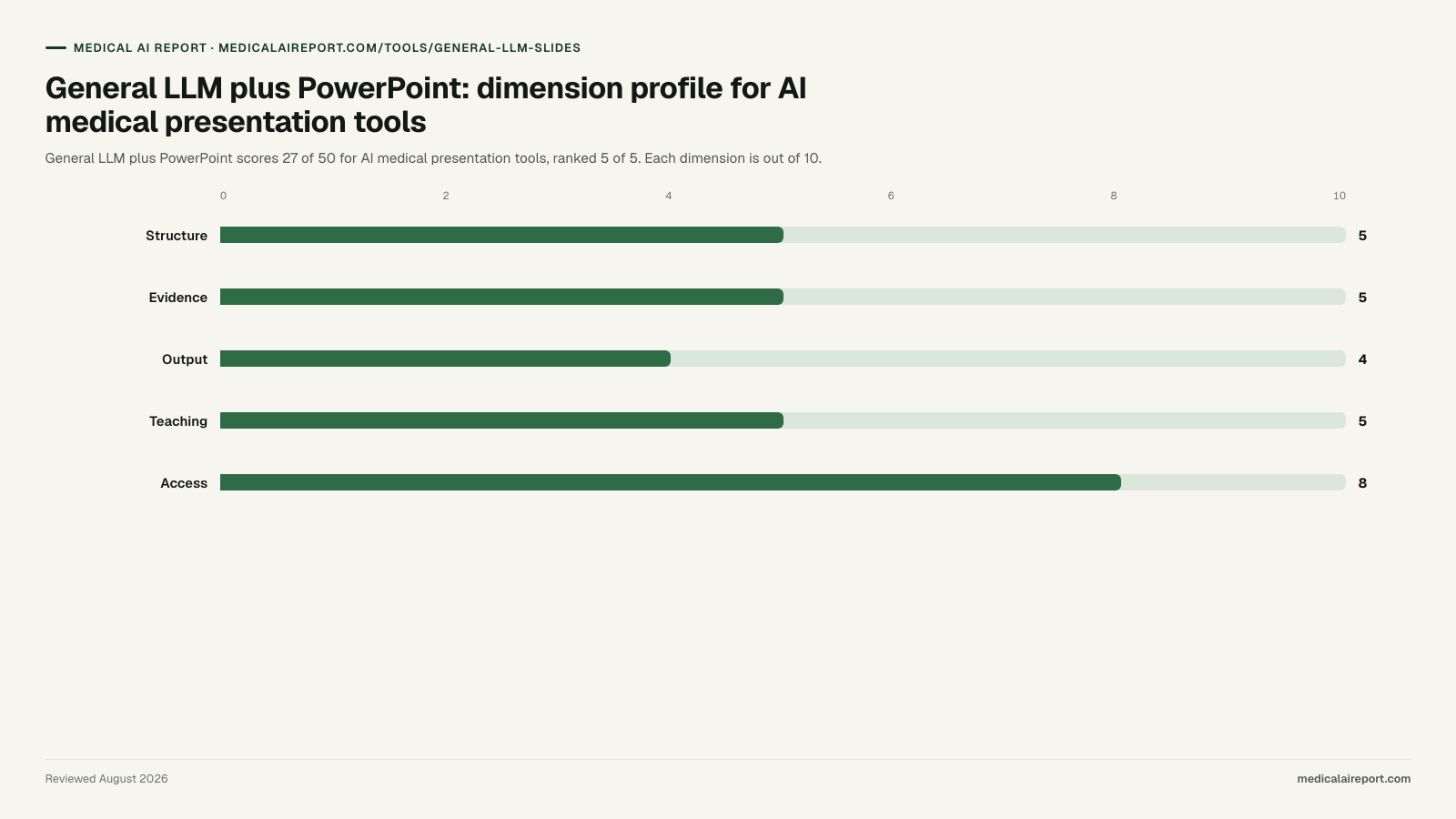
27/50
5th of 5
| Clinical structure | Evidence integration | Deck & data output | Reasoning & teaching depth | Access & price |
|---|---|---|---|---|
| 5/10 | 5/10 | 4/10 | 5/10 | 8/10 |
- Best for
- Drafting narrative and teaching points when you are comfortable building slides, charts and citations yourself.
- Limitation
- No real chart generation, no OCR, and citation accuracy must be verified manually because fabricated references are a known failure mode.
- Price
- Included in an existing LLM subscription
Dimension-by-dimension rubric criteria for AI medical presentation tools
- Clinical structure5/10
Category high: 10/10
Whether output follows the format a clinical audience expects — history, examination, workup, ranked differential, management, teaching points — and whether templates exist for grand rounds, M&M, journal club and tumor board.
- Evidence integration5/10
Category high: 10/10
Access to PubMed, Google Scholar and trial registries, correct AMA or Vancouver citation formatting, and whether references are retrieved from primary literature rather than generated from memory.
- Deck & data output4/10
Category high: 10/10
Whether the tool produces finished slides, generates real charts from clinical values such as trended labs or survival curves, reads scanned records via OCR, and exports cleanly to PowerPoint for hospital audiovisual systems.
- Reasoning & teaching depth5/10
Category high: 10/10
Whether the tool explains why one diagnosis outranks another rather than listing possibilities, and whether it produces the discussion, pitfalls and teaching points an audience of clinicians is there to hear.
- Access & price8/10
Category high: 9/10
Free tier, published pricing, and whether a resident preparing one talk can use it without an institutional licence.