
AI billing & coding review
Ranked firstBest autonomous coding for large health systems
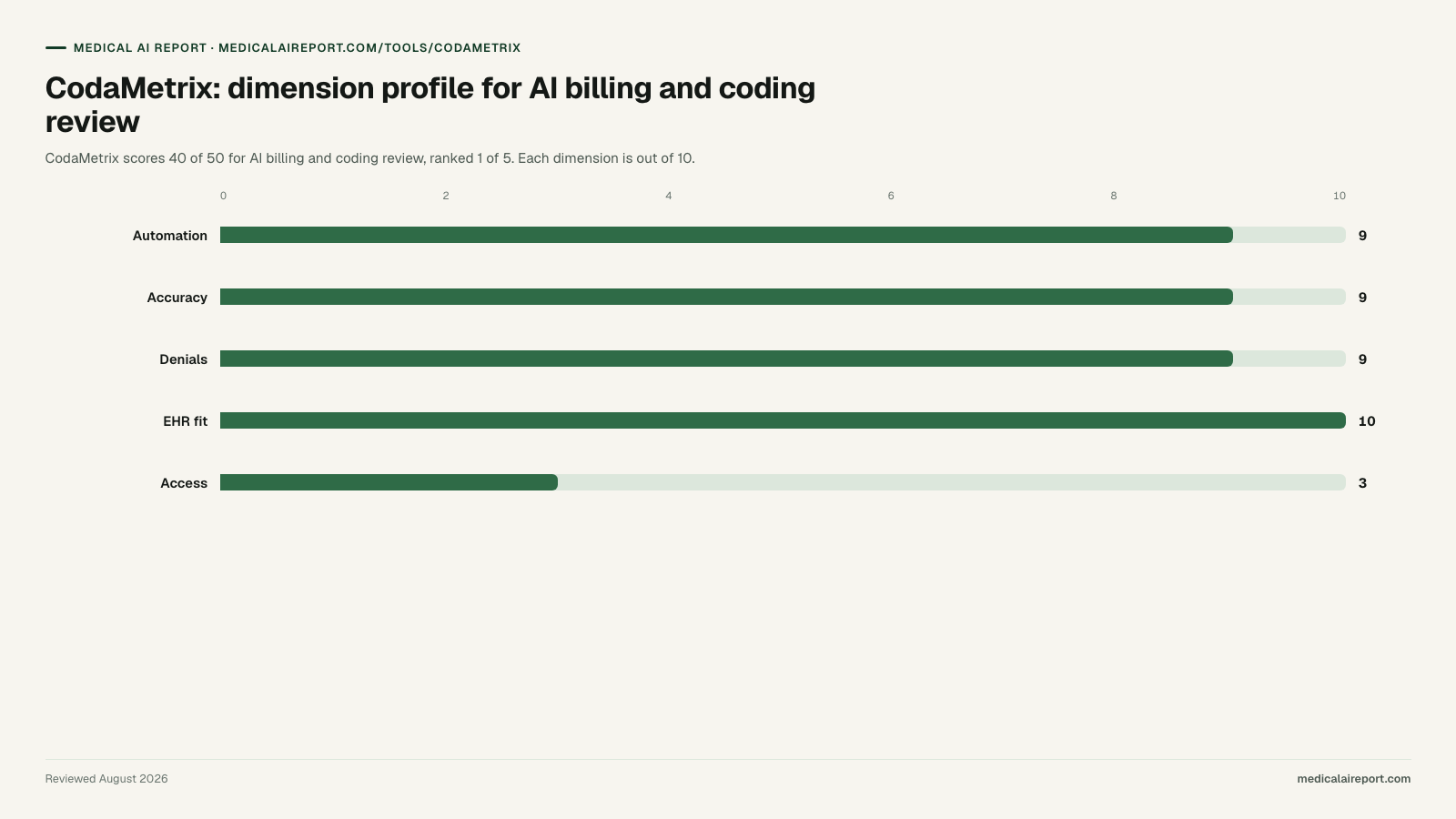
40/50
1st of 5
| Automation rate | Coding accuracy & explainability | Denial prevention | EHR & deployment | Access & pricing transparency |
|---|---|---|---|---|
| 9/10 | 9/10 | 9/10 | 10/10 | 3/10 |
- Best for
- Health systems above roughly 200,000 annual encounters running Epic or Cerner, where a coding backlog and denial rate are material to cash flow.
- Limitation
- No published pricing and no path for a small group: this is a six-figure enterprise commitment scoped to case volume, and it operates after notes are finalized so it does not reduce documentation burden.
- Price
- Enterprise only, disclosed under NDA; six-figure annual commitments
Dimension-by-dimension rubric criteria for AI billing and coding review
- Automation rate9/10
Category high: 9/10
Share of charts coded end to end without human touch, and whether the vendor reports that rate by specialty rather than as a single headline figure.
- Coding accuracy & explainability9/10
Category high: 9/10
Code-level accuracy against auditor review, confidence scoring, and whether a coder can see why a code was assigned well enough to defend it.
- Denial prevention9/10
Category high: 9/10
Documented effect on first-pass clean claim rate, denial volume and discharged-not-final-billed backlog, weighted toward independently reported outcomes.
- EHR & deployment10/10
Category high: 10/10
Depth of Epic and Cerner integration, longitudinal record access versus encounter-only context, and implementation burden.
- Access & pricing transparency3/10
Category high: 10/10
Whether pricing is published or disclosed only under NDA, the minimum viable volume, and whether a mid-market group can buy without a six-figure commitment.